Powder Coated vs Galvanized Safety Rails
When you’re comparing powder coated vs galvanized safety rails, it’s important to understand how each one holds up in the field and how it performs once it hits a real jobsite.
At a basic level, both systems are designed to meet fall protection requirements.
You’ll see both used across construction projects, and on paper, they can look pretty similar.
The difference shows up after they’ve been used for a while in the field.
Powder-Coated Rails
Powder-coated rails are steel with a layer of paint applied to the outside. That coating is there to protect the steel from the elements and give it a clean, uniform look.
Hot-Dipped Galvanized Rails
Galvanized rails are built differently. Through a process called hot-dip galvanizing, the entire rail is submerged and coated inside and out. That means the protection is not just on the surface. It is throughout the material.
That difference might not seem like much at first, but on a construction site, it makes an impact over time.
What Happens in Real Jobsite Conditions
Construction sites are hard on equipment. Rails get moved, dropped, hit, and handled every day.
With powder-coated systems, everything depends on that outer coating holding up. It doesn’t.
They get scratched during installs. Nicked in transport. Hit by tools and equipment.
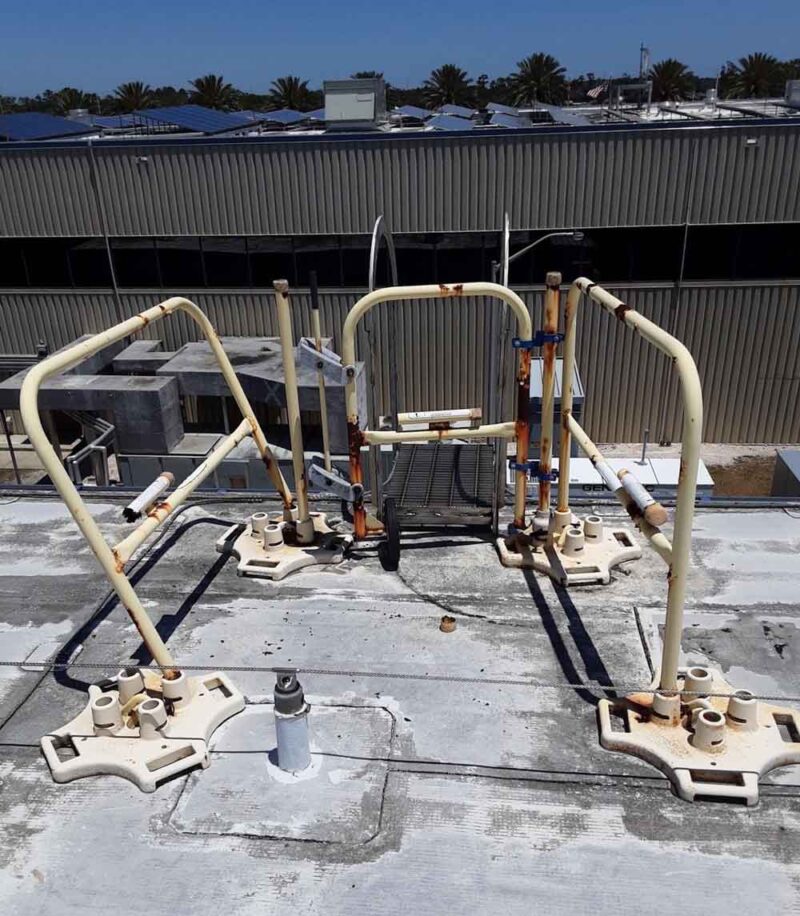
Once that coating breaks, the steel is exposed.
From there, it’s simple. Moisture gets in. Rust starts.
Sometimes you see it. Sometimes it’s happening where you can’t see it. Either way, it doesn’t stop.

Why Galvanized Steel Holds Up Better
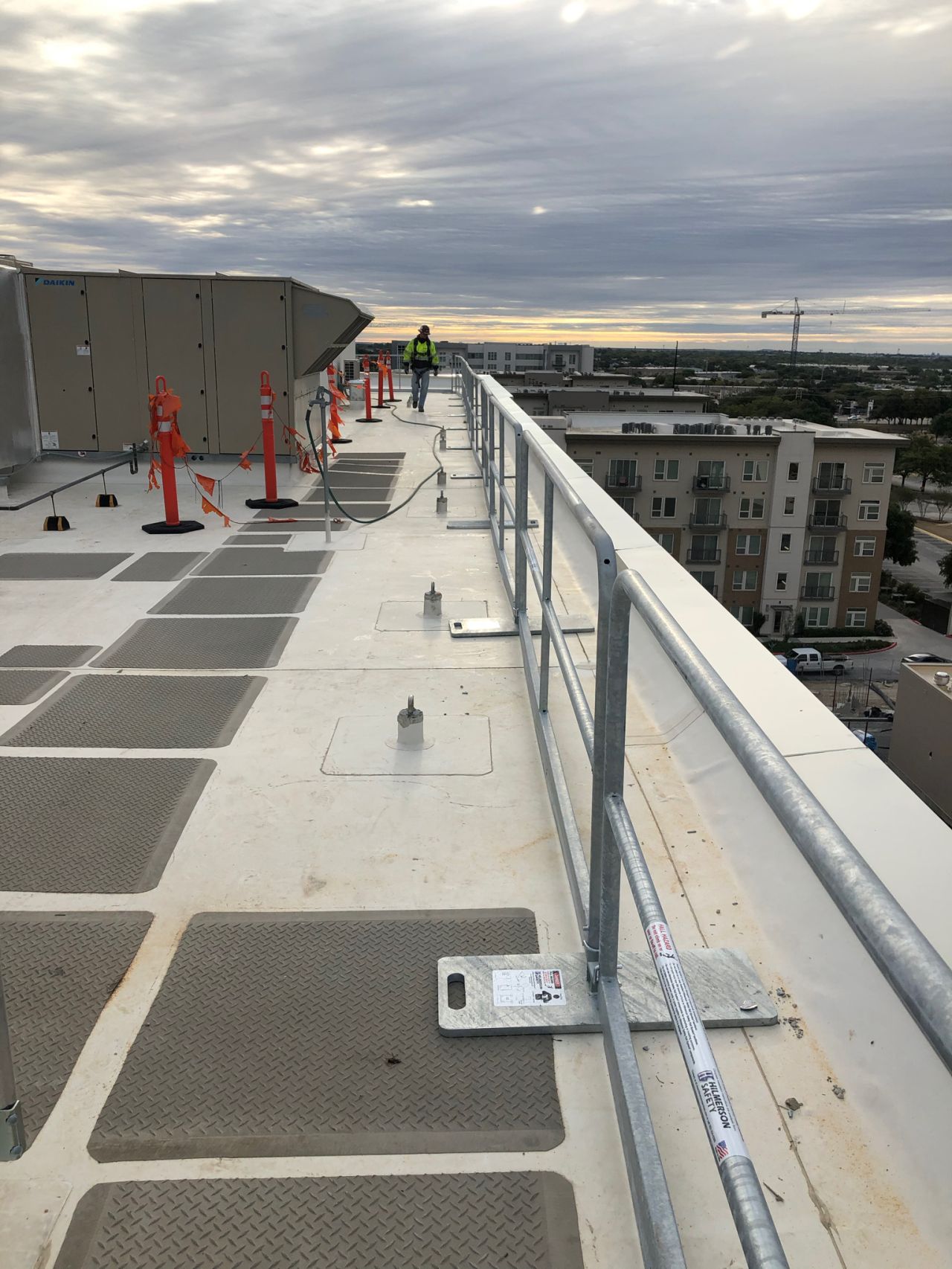
Hot-dip galvanized steel takes a different approach. Instead of relying on a surface coating, the entire rail is protected. The inside, the outside, and the areas you cannot see all have the same level of protection.
If a galvanized rail gets scratched or bumped, you are not immediately exposing vulnerable steel the same way you are with a powder-coated system. The protection is still there, which helps prevent corrosion from starting.
Over time, this leads to less rust, less maintenance, and a longer usable life.
Why This Impacts Safety
When you are dealing with fall protection, materials are not just about durability. They are about safety.
If a rail starts to rust, it starts to weaken. If it weakens, the system is no longer performing the way it should. That introduces risk for the people relying on it.
That is not something any crew wants to deal with on a jobsite.
The decision between powder coated vs galvanized directly affects how reliable that system is over time.
Looking at Long-Term Value
There is also a cost side to this that often gets overlooked.
Powder-coated systems are usually less expensive upfront, which is why they are often selected to meet minimum OSHA requirements. Over time, maintenance, replacement, and performance issues start to add up.
Galvanized systems typically cost more at the start, but they last longer and require less maintenance. That means fewer replacements and more consistent performance across multiple projects.
When you look at the full lifecycle, the return on investment becomes clear. Over time, the savings shift to galvanized.
What We Saw Installing Other Systems
After working with different guardrail systems over the years, a few patterns started to show up pretty quickly.
The issues were not random. They showed up in the same places, over and over again.
Hot Spots
One of the biggest problem areas was where forklifts handle the rails. On most job sites, rails get picked up, moved, and staged constantly. When forks grab the rails in the wrong spot, that is where you start to see bending, denting, and eventually coating failure.
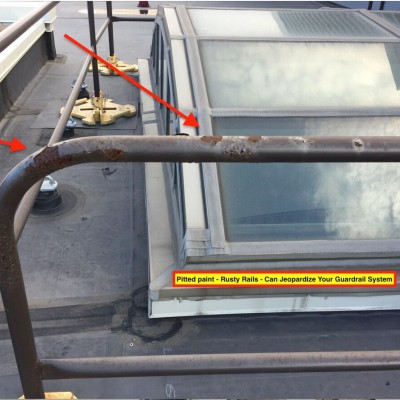
Once that coating breaks down, especially on a powder-coated system, you are right back to exposed steel and rust starting in those high-impact areas.
That is exactly why we added a vertical post to our system. It gives added strength in the area where damage typically happens, so even if it gets handled roughly, it holds its shape and keeps performing.
Not every contractor is going to invest in a mobile cart right away. So the system is built to hold up either way. The cart helps with organization and protection, but the strength is built into the rail.
Where Other Systems Start to Break Down
Another issue we saw consistently was in how the rails were built and connected.
Most systems use pinched connections that are welded together. Over time, those pinched areas become weak points. When you look at older systems in the field, that is often where you see damage first.
“Once that paint nicks and it’s exposed to the elements, you’re going to get rust,” said Debra Hilmerson, President and CEO of Hilmerson Safety. “And when you have rust in a safety system, you have liability.”
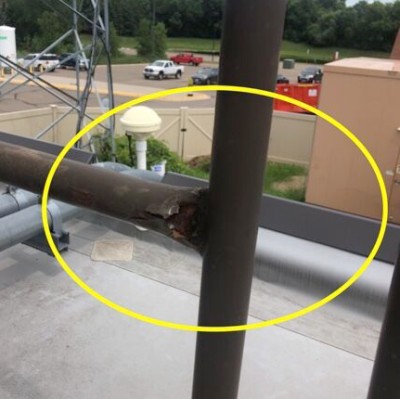
It is also where rust tends to show up.
When those areas are coated and then stressed, the coating starts to fail. Once that happens, corrosion sets in, and the integrity of the system starts to decline.
We took a different approach.
Instead of pinching components together, we cope everything. That creates a cleaner connection and eliminates that built-in weak point. It is one of those details you might not notice right away, but it makes a difference over time.
Designed With the Jobsite in Mind
Everything about the system comes back to how it is actually used in the field.
Construction crews are tough on equipment. That is not a flaw. That is just how the job works.
So instead of designing something that looks good on paper, we focused on building something that holds up under real conditions.
That includes:
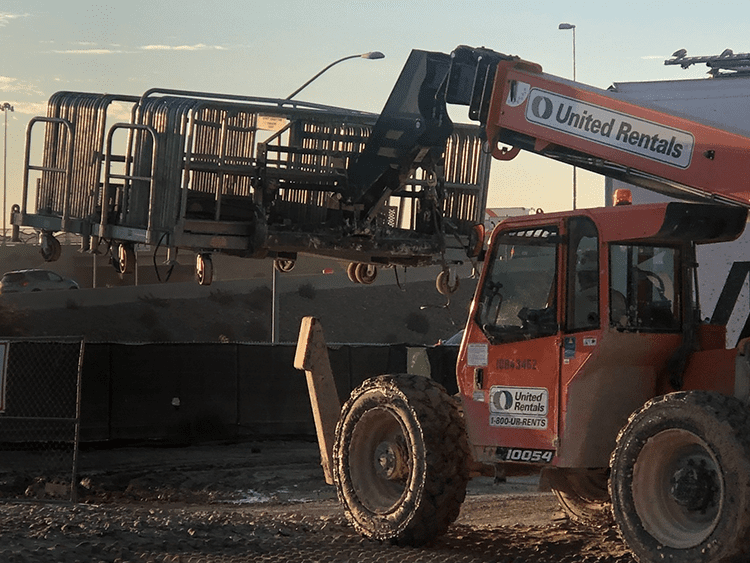
- Reinforcing areas where damage usually happens
- Eliminating weak points in connections
- Keeping the system simple so it gets installed correctly
Because the more complicated something is, the more likely it is to be installed wrong or worked around.
Built for Strength, Not Just Compliance
There are a lot of systems that meet minimum requirements.
That was not the goal here.
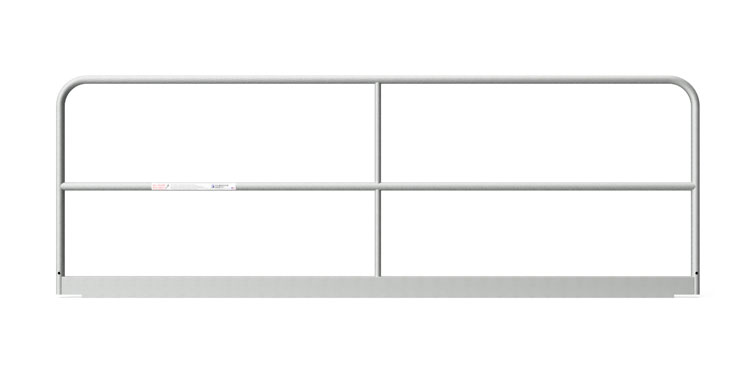
We built this system using 13-gauge hot-dip galvanized steel, modeled after scaffolding that has already proven itself in the industry. It is designed to hold up to repeated use and the kind of wear that comes with active construction sites.
It also includes the features crews expect:
- 42-inch top rail
- 21-inch mid-rail
- Optional integrated toe board
A Better System for the Way Crews Actually Work
When you put all of this together, it comes down to one thing.
We took what was already out there, looked at where it failed, and made it better.
Not more complicated. Not over-engineered.
Just stronger where it needs to be, more durable over time, and easier for crews to use the right way.

About Hilmerson Safety
Hilmerson Safety® is a full-service safety product design and manufacturing company serving the construction industry. Since 2001 Hilmerson Safety® has been working with construction industry leaders and contractors to develop safe, lean, construction-grade™ products and solutions that add to the company’s bottom line.
For more information email us or call (952) 239-0125